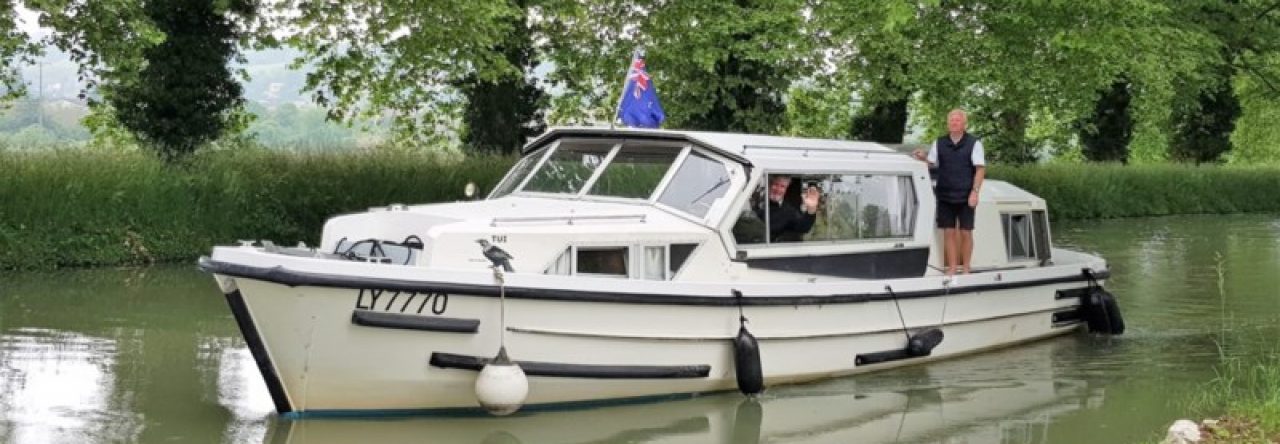
Boat Handling & Locking
The ‘Waterways Guide’ covers the speed limits, distances, and canal dimensions but remember that tree roots protrude out into the water and narrow the canal in places.
Nevertheless, there is ample room to pass but don’t underestimate the lack of skill or ignorance of the rules of other (Hire) boat drivers.
There is a book on board which explains the full canal Navigation Rules and Signage. We suggest that you keep this with you at the Helm, in practice though the signs are pretty self-explanatory.
- Keep right, especially when passing oncoming boats.
- Give way to boats travelling in your direction ahead of you. When clear to do so and if you wish to, pass them to their left.
- Give way to boats travelling down-stream.
- When berthing stern-to or tying-up canal side, do everything S-L-O-W-L-Y and have the crew ready to fend off with a boat hook or mop.
It is a good idea to be prepared to fend off or help others, who may be attempting to berth beside you (actually to avoid them crashing into you).
Shout at them if you think that they are going to hit.
The two main errors that they will make are to come in too fast; and to keep backing and filling when almost in the berth, thereby making it difficult for anybody on the ropes.
If only they would turn off the engine when the ropes are ashore!
Even the big boats can be pulled into place with the engine off.
Berthing at a Port
It is a good idea to berth at a Port about every third day to:
- Recharge the household batteries,
- Replenish the water and,
- Very occasionally top up the diesel tank.
Some people prefer to do this every night as the ports have motor camp style showers, toilets and usually washing machine with dryers.
There is a “Capitainerie” at each port whom you will need to pay (about 10 to 20 Euros per night) once you are tied-up (usually stern-to) but occasionally alongside. It is a good idea to phone ahead and book a berth during the busy season unless you are going to arrive fairly early in the afternoon (phone numbers in the Canal Guides).
Watch out that you don’t park where the restaurant or hotel boats park. We often stay in the same Port for two or three days to explore the local area.
Before commencing the berthing manoeuvre, make sure that the crew are all deployed to fend off if need be.
Berthing manoeuvre (90 degree turn)
Note:- Steering is sluggish when going astern until some way is on, so be
careful when reversing.
As an example – when approaching a berth on the left hand bank from the right of the berth, berthing stern to the jetty :-
Firstly, do it all slowly!!
- Firstly, do it all slowly!!
- Draw up in the stream with the boat’s midships level with the berth, making sure that you are well clear of any obstructing parked boat.
- Put the helm hard over to starboard and apply a little throttle to kick the bow into a right-hand turn.
- This will cause the stern to rotate towards the berth on the left-hand bank.
- When the boat has cleared any obstruction and when you judge that the long axis of the boat is lined up with the berth put it into reverse.
- Gently back into the berth. If you are approaching faster than snail pace apply a little forward thrust to slow up your reverse speed.
It is often a good idea to put the engine into neutral when the stern is about half a boat length from the jetty, nudge back against and have somebody fend any neighbouring boat, and then physically pull TUI to the berth.
Quite often the neighbours will catch a line and pull you in anyway.
Turning manoeuvre – due to her natural propeller handing, you will find that Tui will turn slightly better to starboard when going ahead and to port when going astern.
As an example – Turning to the starboard.
Choose a wide section of the canal with soft, fiberglass-friendly edges.
Repeat 1) and 3) above.
- Put the boat into reverse (maintaining the full starboard lock) while the boat is still turning, Back-up as far as is safe-remembering the vulnerability of the rudder and prop. Have somebody on the stern to call out how far you are from the bank.
- Motor forward, again maintaining the full starboard lock. This will re-activate the turn. Stop before you hit the bank!
- Repeat 1), 3), 4) and 5) above until the turn is completed – maybe 2 or 3 times to get right around. (If it all goes pear shaped blame the crew –that’s what they are there for).
- Reward yourself with a celebratory Gin!!
With both of these manoeuvres you can obviously turn in the opposite direction by using full port lock.
Tying-Up
There are bollards or steel rings on the jetty to make fast to.
- Make sure that the rear fenders are placed so as to keep the stern from contacting the jetty.
- Then pass a loop of stern line through the ring and back over the onboard stern cleat.
- Then pull up on the free end and tie it off on the cleat with two or three figure ‘8’s and a half hitch.
- This will allow you to cast off from on board without getting it wet and will result in 4 parallel sections of line between cleat and ring.
Sounds complex, but look around and copy the other boats.
Freedom Parking/green mooring
If you prefer to park in some quiet and romantic location canal side you are fully
entitled to do so and there is no cost.
Avoid parking on bends though, and also under trees if there are storm conditions.
When parking where ever, there are likely to be rocks or tree roots protruding (just about everywhere unless there is a jetty with bollards) go in very slowly at an acute (ie. almost parallel to the bank) angle to the shore always moving forward.
- Nose the bow into the banks and let crew off.
- Once the deckhands are ashore put the motor in neutral and let them pull you in using the bow and stern lines.
- When departing it is best to push the stern out by hand then back well out into the stream, before engaging forward gear and turning gently away from the bank.
- These precautions are to avoid wiping out the rudder and prop! It will be a long way back to the nearest haul-out facility and pulling the boat gets tiring after a kilometre or two.
There are 2 heavy steel stakes and a small sledgehammer in the grey pod on the rear roof. Use the stakes with the loops.
- The stakes must be pounded VERY securely into the ground on the canal side of any walkway or cycle path otherwise you will be woken by the cursing of a grazed and bruised early morning French cyclist.
- Once you are tied up to the stakes check to see what happens to them when another boat’s wake rocks TUI.
- Sometimes, if they are not secure, they may pull out, in which case you could find yourself downstream in unfamiliar surroundings in the morning.
- Don’t tie up to trees- the French don’t like it because it may transmit the
- disease that is killing the plane trees- and they are usually on the landward side of a path in any case.
- There is a Gangplank (Passarella) on the rear cabin roof for elegantly stepping ashore when freedom parking (not when in a Port).
- When putting it back on the roof, make sure the scratchy bits are pointing up.
We have never used this, as the bank levels are always about right seems.
Locking
These instructions vary depending on how many people are on board.
The lock keepers are usually (but not universally) helpful if asked.
- Can you help me please?
- Vous pouvez m’aider s’il vousplais ? (‘Voo Poovay mayday see voo play?) …
- then afterwards…
- Thank you very much. Merci beaucoup (mercy bow koo ! -‘bow’ as in ‘bow and arrow’)
- then Good-bye Au revoir. (Or vwar.)
The lock hours are 9 am to 7 pm with a closure for lunch which varies nationwide.
Lunch to them is sacrosanct so plan your arrival time at locks carefully to avoid long waits – up to 2 hours if you strike lunch and siesta.
Going downhill is easier than going uphill. If you get the chance drive to the lock wall closest to the driver’s side of Tui – you can best judge how close you are to the wall when it is on this side.
You may not get this chance if you are last boat into a lock.
If Locking going downstream:
- Motor slowly ahead once the lock gates open;
- Then pull to a side and have crew/s step off with a rope each.
- Secure the stern line first, then the bow line by looping them half way round the nearest bollard.
- Then step back onto the boat.
DO NOT TIE THE LINES OFF or DOUBLE THE LINES around the bollards.
Otherwise the boat will be left hanging on its side in mid-air!!
- Pay out line slowly as the water level goes down.
- When the gates open retrieve the two lines trying not to get them wet
- Then get the forward hand to push the bow out with a boat hook or mop
- Then motor ahead slowly avoiding the edge of the gate (harder to do than it sounds).
Crew should use gloves when handling lines or at least wash hands afterwards.
Don’t park too close to the front or rear gates as there is a concrete sill
protruding from under the gates which may damage the hull.
When locking going upstream:
- It is necessary to have a crew member up on the side of the lock, so put a
crew-member with a boat hook off at the jetty near the lock gate. - When the gates open motor in slowly and either throw the line up to the onshore crew or hand the line up to his/her waiting boat hook.
- Secure the bow line first, then the stern line.
- Again, do not tie them off-merely loop them over the bollards and hand back down to onboard crew who will retrieve line as TUI ascends.
- It is preferable to be the rear boat or only boat in the lock when locking up, as the front boat can get considerable spray from sluices opening as lock fills up. Not ideal if avoidable.
Note: There is now a centre cleat fitted on the port side by the driver’s station, and once you are more experienced in locking, it is easy to control the boat with only this one line on. In that case, the driver can either hand the line-up, or the crew pass a line down. We find passing a line down the easiest by far.
Before the onboard crew cast-off, the onshore crew-member should be able to step back onboard from the lock side (otherwise throw them 20 euro for a train ticket and leave them behind).
Some locks have vertical steel rods in recesses in the walls-this makes it easy as
securing can be done from onboard the boat by looping lines round the rods.
It all sounds rather complex but you soon get the hang of it. Once you have, it is fun watching the screw-ups and impending divorces occurring on other boats, which generally happen early in the week for hire boats and decrease as their skill level improves.
There is no charge, or tip expected for using the locks. We pay a one-off yearly fee for using the locks and the canals. We also carry insurance for TUI but don’t really want to put the French Insurance Company to the test!
 Canal Boat Tui