Canal du Midi ~ Carcassonne ~ Robine Canal ~ Narbonne

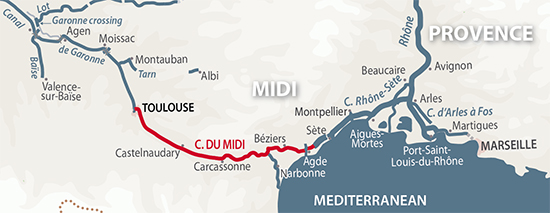
The Canal du Midi, designed and built by Pierre-Paul Riquet in 1662-1681, is a remarkable work of engineering, justifying its inclusion in the Unesco world heritage list in 1996, and one of the most popular cruising waterways in France. 2016 marks the 350th anniversary of the royal decree authorising Riquet to build the canal, and the 20th anniversary of the world heritage listing. The canal runs 240km from the Étang de Thau, a sheltered lagoon behind the Mediterranean port of Sète, to Toulouse, where it connects with the Canal de Garonne. Its green waters twist and turn through the countryside, following the contours, bordered by an avenue of thousands of plane trees whose exposed roots interlock at the water’s edge, reinforcing the banks.
Although many have been cut down to limit the spread of the deadly canker stain, a minute blue fungus, the characteristic landscape remains in many sections, and the newly-planted trees will gradually recreate the majestic presence of their predecessors. The canal passes through a great number of wine-growing areas, including the Hérault, the Aude, Minervois and Corbières, as well as many fields of sunflowers and corn. These dominate the more pastoral landscape after the canal leaves the Mediterranean climate west of Carcassonne.
The Midi has just cause to be popular. During the season hundreds of hire boats cruise to and fro, not always completely sure of what they are doing, particularly in the locks (tricky enough for more experienced boaters). These are subject to a perpetual overflow waterfall noisily cascading over the upper gates. It pays to be somewhat on guard when sharing a lock with hire boats. The quantity of hirers naturally increases during the grandes vacances in July and August. Thefts from this tempting array of targets are not unusual, so boats should always be locked up!
From its entrance at Les Onglous, marked by a charming small lighthouse, the canal cuts across the coastal plain to Agde, where it crosses the river Hérault behind a weir, then enters its lowest pound at the round lock in Agde. It leaves sea level at the lock in Portiragnes, and soon reaches Béziers, where the canal crosses the river Orb, this time on an aqueduct. Here starts the ‘heavy engineering’ of this truly unique canal, where nature forms a constantly delightful backdrop to all manner of staircase locks, aqueducts, siphons, spillways, feeders and one tunnel.
At Fonserannes the six- (formerly eight-) lock staircase lifts boats to the ‘long pound’ (grand bief) which follows the 31.50m contour for no less than 54km to Argens-Minervois. This includes the world’s first canal tunnel, at Malpas, with a length of 161m and a width of 6.45m at water level. From Argens the canal climbs again in earnest through Carcassonne then Castelnaudary. A few hours after leaving Castelnaudary and its expansive basin, the summit level is reached. Here it is worth stopping where the feeder enters (photo, right) to visit the former octagonal basin, the Rigole de la Plaine feeder, and the imposing obelisk erected in Riquet’s memory. From Toulouse the canal rises through the rich cereal-growing plain of the Lauragais to a short summit level at the Col de Naurouze, at an altitude of 190m. It is to this point that Riquet succeeded in bringing a more-than-adequate supply of water by an ingenious feeder system, the main components of which are the Saint-Ferréol reservoir, still efficient after more than three centuries of operation, the Rigole de la Montagne, 24km long, and the Rigole de la Plaine, 35km long. The large-scale development of irrigation from the 1970s, combined with maintenance problems and the resulting wastage of precious water, and a series of exceptionally dry years, stretched this system beyond its limits, but additional resources have been made available (a new reservoir at Montbel supplying the Ganguise reservoir by gravity), so that all the canal’s functions are in principle guaranteed even in the driest summers.
The important La Nouvelle branch, often called La Robine, leads from the main line at Sallèles (PK168) via Narbonne to the commercial port of Port-la-Nouvelle, a distance of 37km.
A short branch, the descente dans l’Hérault maritime, leads from the round lock at Agde to the river, thus giving alternative access to the Mediterranean. East of Agde lock, the canal uses the course of the Hérault for 1km (see under Hérault).
History – France’s most famous canal was born, like many great projects, from a meeting of men with uniquely converging motivations and capabilities. Tax collector Pierre Paul Riquet saw the value of the canal crossing the watershed, connecting Toulouse to the Mediterranean. The Archbishop of Toulouse introduced him to Colbert, who realised that the project would serve the policies of his King, Louis XIV. The concession was given to Riquet, and works began in 1662. The fascinating story of the canal’s construction is told by Tom Rolt* in From Sea to Sea. The canal was ceremonially opened in October 1681, 10 months after Riquet died, ruined after investing his entire fortune in the works. Vauban made a number of improvements in the 1690s, but was understandably impressed by the boldness of the project completed by Riquet and his engineers. * Co-founder and main inspiration for the Inland Waterways Association in the UK; the centenary of his birth was celebrated in 2010.
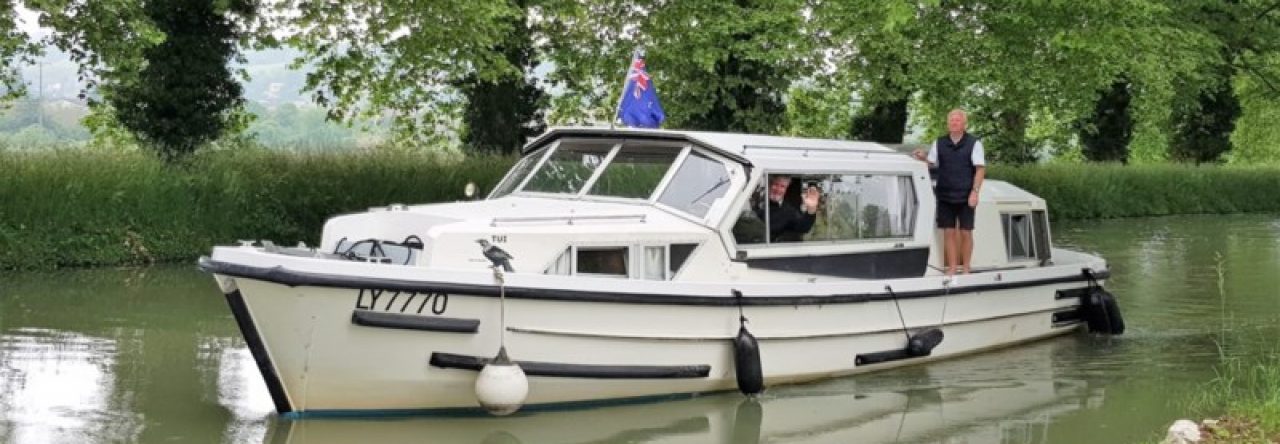
 Canal Boat Tui