There is work being undertaken on the Canal du Midi towpath. This means some diversions and detours. Please check locally at tourist offices and via your accommodation/bike hire providers for the latest information.
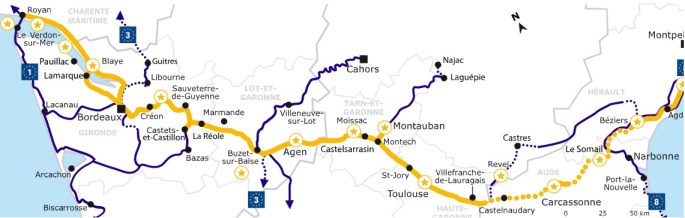
Stretching from Bordeaux to Toulouse, the Les Canal des Deux Mers – the Canals of the Two Seas – link the Atlantic to the Mediterranean. The route is made up of the Canal de Garonne and the Canal du Midi, and it can be cycled from one end to the other in 10 days at a pace that leaves plenty of time for exploring.
To travel between Bordeaux and Sete involves three waterways, starting with a 53km section of the Garonne River from Bordeaux to Castets-en-Dorthe. Afterwards, you follow the Canal de Garonne for 193km before arriving in Toulouse. From here, Sète is a 240km bike ride along the Canal du Midi.
The history of the Canal du Midi
It had been the dream of many – from Caesar Augustus to Louis XIII – to connect the Atlantic and the Mediterranean, providing a safe inland route that avoided the treacherous voyage around the Iberian peninsula with its storms and pirates. The lack of money and technical difficulties proved insurmountable until 1662.
A brilliant civil servant by the name of Pierre-Paul Riquet had become obsessed with the project, and he believed he had the solution. He proposed digging a canal between Sète and Toulouse, and connect it to the Garonne via Bordeaux and on to the Atlantic. Work began on April 15, 1667, with the speed of the project remarkable considering men using picks and shovels dug the canal, in the process removing 7 million cubic metres of earth over 240km. The Canal du Midi was completed in May, 1681, some 200 years before the Canal de Garonne.
The Canal du Midi quickly became a major route for cargo and passengers, and opened cities such as Toulouse and Carcassonne up to trade. Specially designed freighters were built for the canal and towed by horses; these were capable of carrying loads of 120 tons – much more than carts travelling by road.
At any time there were as many as 250 freighters plying the canal, the journey between Sète and Toulouse taking about a week. The cargo was mainly wine, dried fish, cereals and fruit. Passengers, meanwhile, were carried on horse-drawn boats called mail carriages.
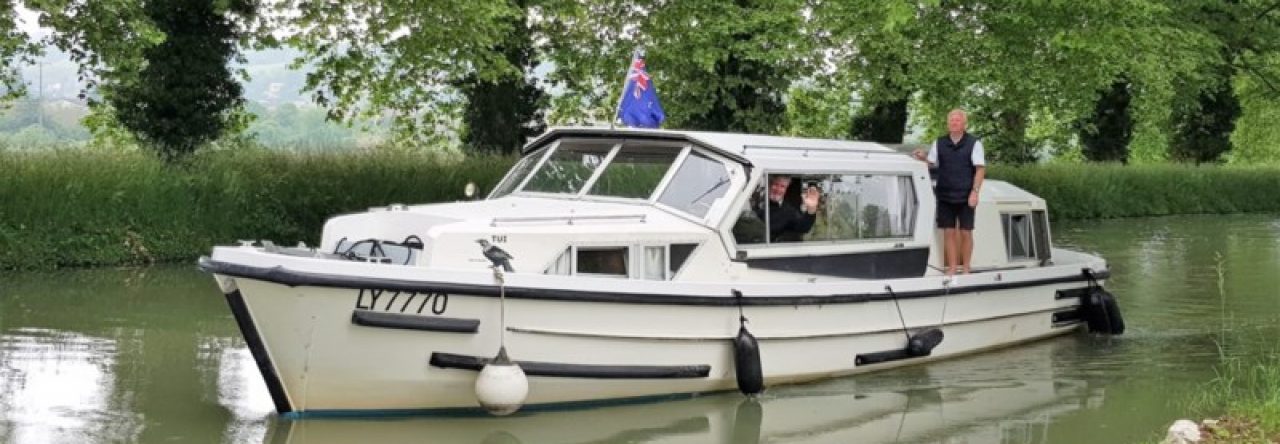
 Canal Boat Tui