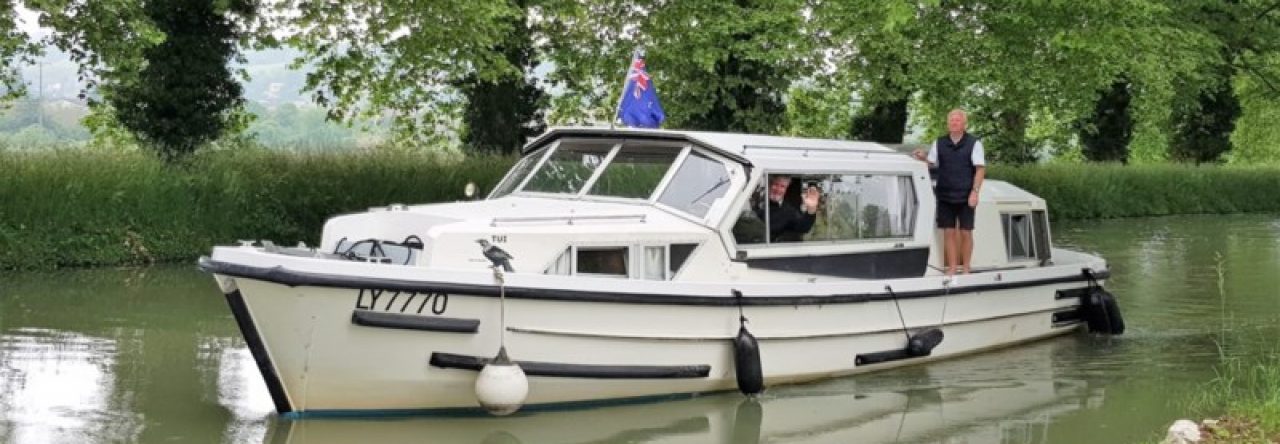
Waking-up TUI at the beginning of the season
Prior to going back into the water:
You will have to tell the yard the date that you will be there and ask them to take the plastic wrap off ready for your arrival. They will organize a ladder so you can access the boat.
- Remove all orange 50mm wide tape from hull fittings etc.
- Take down the night curtains gently, they are velcroed up.
- Reconnect house batteries found under the saloon floor.
- Reconnect engine start battery found in engine room under the gen set
wooden platform - Connect to shore power and put battery charger on ‘recondition’ mode to
charge household batteries. The yard will help with getting a lead to the
boat for power. - Turn on power switch to left of steering wheel.
- Check gauges on dash to assess charge in household and starter
batteries. You will need to turn the ignition switch to on for the gauges to
work. - Check engine oil level, fan belts tension and all hydraulic oil levels and
hoses. - Test steering works and check rudder moves.
- Check that water filter in engine compartment is free of leaves etc. It
should be as empty end of 2016. - Put about 20 litres of potable water in the water tank, add a water purifier
pill, wait about 10 minutes then fill the tank-water to ¾ full only (see
above). - Drain about a cup full of diesel out of the tank into a clear jar through
access panel under stairs. Any water due to condensation should be floating
on the bottom. If there is a diesel bug in the fuel, it will show up as cloudy
or flocculant rather than clear. In this instance it will be necessary to add
the appropriate amount of decontaminating liquid-dependent on the amount of fuel in the tank. The fuel sediment container is also located behind a small lift out panel under the rear stairs. - If the boat is out of the water, check hull for damage and integrity of the antifoul layer. The yard can help with any anti-foul required.
- Change impeller and filters every second year (Impeller done 2015) (engine
oil and filters replaced with new September 2016). - Check that all inlet/outlets on hull and decks are clear.
- Remove Bait stations and tape. Put away tarps.
- Bikes, these go on the cabin top one on each side, there are pads for the
peddles to prevent damage. - All fenders back into position, check all inflated or put on new ones which
are on boat. - Get 5 Ropes out of lockers and put two on bow cleats, two on stern
cleats, one black line on cleat by drivers’ station. - Make sure boat hooks are handy, we have the heavy brown one on roof, and
one by the driver’s station. - Gloves ready to handle lines. These should be firm fitting so as not to catch
in lines.
Once back in the water
- Check the water level in heat exchanger (radiator cap)
- There is a ‘Kill’ switch next to the starting battery in the engine compartment which could be turned off. We just discovered this in 2022.
- Start engine when checks complete, and as soon as it is running, check to ensure that there is a constant stream of water coming out of the exhaust should be like a slowish hose in amount.
- Check gas hoses, and turn gas on at bottle. Butane gas bottles are available at big supermarkets.
- Check the level of hydraulic fluid in the red reservoir in the engine compartment. The sight glass is on the forward side of the reservoir and the fluid should be half way up it. Use only red coloured hydraulic fluid. Check occasionally during the season.
- The main fuel tank should be left full during winter. It was left full at the end of season 2016, as were the two spare diesel tote tanks stored in the port rear deck locker.
- The petrol for the gen set should be replaced with fresh at start of season. This is why the petrol tote tank is not full.
 Canal Boat Tui