General Information
These instructions vary depending on how many people are on board.
The lock keepers are usually (but not universally) helpful if asked.
- Can you help me please?
- Vous pouvez m’aider s’il vousplais ? (‘Voo Poovay mayday see voo play?) …
- then afterwards…
- Thank you very much. Merci beaucoup (mercy bow koo ! -‘bow’ as in ‘bow and arrow’)
- then Good-bye Au revoir. (Or vwar.)
The lock hours are 9 am to 7 pm with a closure for lunch which varies nationwide.
Lunch to them is sacrosanct so plan your arrival time at locks carefully to avoid
long waits – up to 2 hours if you strike lunch and siesta.
Going downhill is easier than going uphill. If you get the chance drive to the lock
wall closest to the driver’s side of Tui – you can best judge how close you are to
the wall when it is on this side.
You may not get this chance if you are last boat into a lock.
About Locks
A lock consists of a lock chamber which is brick, stone or metal and holds the water. To allow boats to get in and out, and to keep the water in, there are gates at each end of the lock. Sometimes there is one single lock gate, other times there are two double gates, and these are pushed open by balance beams on the gates.
It is only possible to open a gate when the water levels on both sides are the same. So the top lock will only open when the lock is full of water, and the bottom gate only opens when the lock is empty or nearly empty.
There are paddles on locks which are raised and lowered to control the water flow and alter the level. The cill is a large raised ledge at the top end of the lock which the top gate shuts against.
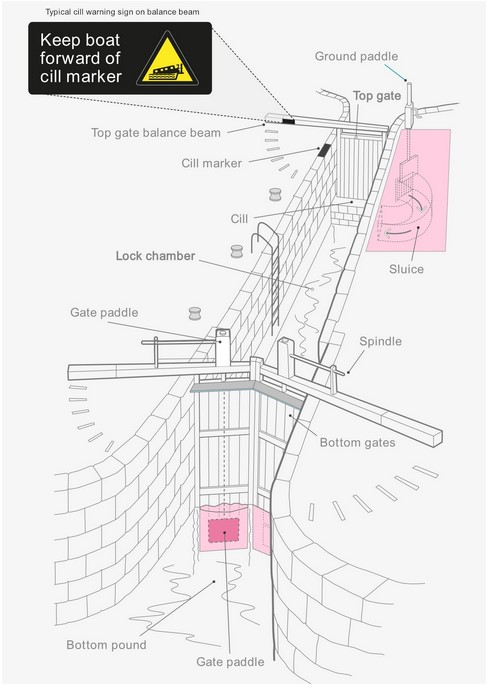
Locks are worked by Water pressure and muscle power
There are no pumps or electric motors except on some of the larger commercial traffic or guillotine locks.
Narrow locks are wide enough for one boat, but wide locks generally hold two boats side by side. They are predominantly found in the South or on wide or barge canals.
If Locking going downstream:
- Motor slowly ahead once the lock gates open;
- Then pull to a side and have crew/s step off with a rope each.
- Secure the stern line first, then the bow line by looping them half way round the nearest bollard.
- Then step back onto the boat.
DO NOT TIE THE LINES OFF or DOUBLE THE LINES around the bollards.
Otherwise the boat will be left hanging on its side in mid-air!!
- Pay out line slowly as the water level goes down.
- When the gates open retrieve the two lines trying not to get them wet
- Then get the forward hand to push the bow out with a boat hook or mop
- Then motor ahead slowly avoiding the edge of the gate (harder to do than it
sounds).
Crew should use gloves when handling lines or at least wash hands afterwards.
Don’t park too close to the front or rear gates as there is a concrete sill
protruding from under the gates which may damage the hull.
When locking going upstream:
- It is necessary to have a crew member up on the side of the lock, so put a
crewmember with a boat hook off at the jetty near the lock gate. - When the gates open motor in slowly and either throw the line up to the
onshore crew or hand the line up to his/her waiting boat hook. - Secure the bow line first, then the stern line.
- Again, do not tie them off-merely loop them over the bollards and hand
back down to onboard crew who will retrieve line as TUI ascends. - It is preferable to be the rear boat or only boat in the lock when locking up, as the front boat can get considerable spray from sluices opening as lock fills up. Not ideal if avoidable.
Note: There is now a centre cleat fitted on the port side by the driver’s station, and once you are more experienced in locking, it is easy to control the boat with only this one line on. In that case, the driver can either hand the line-up, or the crew pass a line down. We find passing a line down the easiest by far.
Before the onboard crew cast-off, the onshore crew-member should be able to step back onboard from the lock side (otherwise throw them 20 euro for a train ticket and leave them behind).
Some locks have vertical steel rods in recesses in the walls-this makes it easy as
securing can be done from onboard the boat by looping lines round the rods.
It all sounds rather complex but you soon get the hang of it. Once you have, it is fun watching the screw-ups and impending divorces occurring on other boats, which generally happen early in the week for hire boats and decrease as their skill level improves.
There is no charge, or tip expected for using the locks. We pay a one-off yearly fee for using the locks and the canals. We also carry insurance for TUI but don’t really want to put the French Insurance Company to the test!
Safety First
You should always ensure the safety of your boat, yourself, your crew, children, pets and bystanders. These are some points to help:
- Take your time with locks – there is no rush and you are on holiday.
- Children and non-swimmers are recommended to wear life jackets and pets kept under control around locks.
- Ensure that you and your crew are wearing suitable footwear, particularly avoiding high heeled, open-toed shoes and flip-flops. A windlass dropped onto bare toes can be extremely painful!
- Always keep one person on the boat when it is in a lock.
- Secure spectacles, loose hair or clothing, scarves tucked in, avoid wearing anything around the neck, like long necklaces, cameras, shoulder bags etc. which can catch on the windlass or in the paddle mechanism.
- Do not allow small children to touch the mechanisms around the locks and make sure they are supervised at all times.
- Keep children away from the lock edge and watch out for slippery surfaces.
Lock Ettiquette
If a Lock keeper is on duty, always follow their instructions. You will usually be expected to operate the locks yourself, but under instruction or supervision. Some locks, particularly on rivers are always operated by Lock-keepers. Most locks, however, are self-operated.
If the water is in your favour, you have right of way; if the water is against you then a boat seen coming towards you has right of way, as they can make use of the water.
You may have to wait a few minutes for the oncoming boat to get into a position to use the lock – please be patient.
Do not be tempted to use lock moorings for overnight stays or moor there for longer than it takes to lock as you will be obstructing other users.
If a boat is coming towards you as you exit the lock, leave the gates open for them.
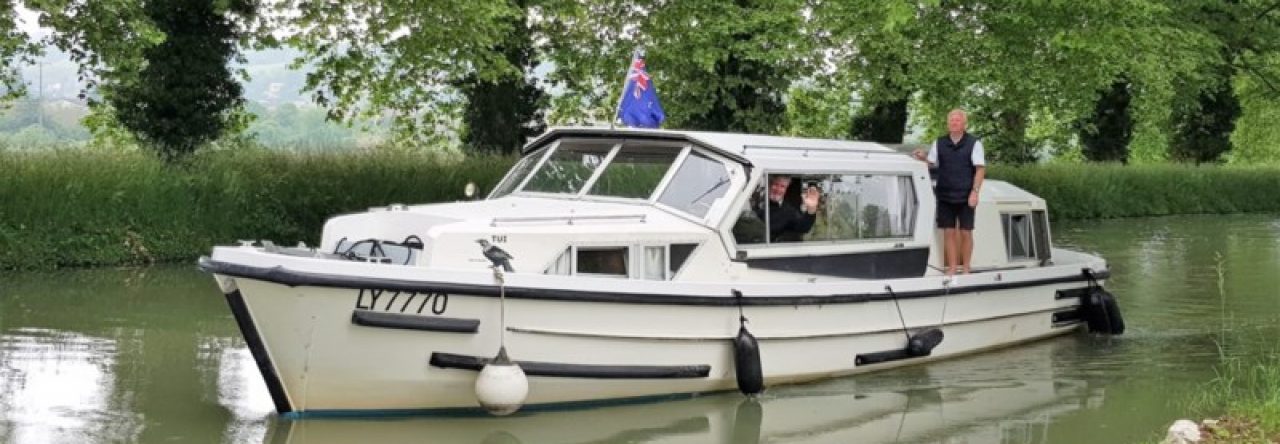
 Canal Boat Tui