Water
The water from the Ports is usually town supply, it is your choice to drink it or buy bottled water. (Best to drink bottles water)
The water pressure is provided by a pump which comes on when the taps are turned on. This makes a ‘purring’ noise. You need to ensure that all taps are turned off fully so the pump doesn’t kick in and disturb you, particularly at night.
6/8/22 – after de-winterisation we had a couple of occurrences whereby the water just stopped ie. No water came out of the tap. We rectified this by running the motor, until the water flowed again (few seconds).
Filling the water tank.
- The tank holds 600 litres.
- The filler is the forward of the two fillers on the port side on the deck near the steering wheel.
- The ‘key’ (a large thick wire double prong) to open the filler cap is hanging on a hook near the rear exit door.
Be careful that the cap and key can’t fall into the canal.
There is not a spare.
The YELLOW hose is to be used for filling the tank. There is a stretchy hose that can be added for extra length if needed.
On no account let it dangle in the canal water.
- The fittings for the onshore taps are stored in a box under the salon couch -there are a range of them as they vary from Port to Port.
- Usually the water price is included in the overnight berthage price, but occasionally there is a coin operated supply.
- Add water purifier tablets occasionally.
- The water tank gauge is to the left beside the driver’s seat.
- The access panel to the water tank is under the saloon floor forward by helm station.
- Periodically check for water in the bilge beside the water tank.
- The tank is actually full when it reads ¾ full.
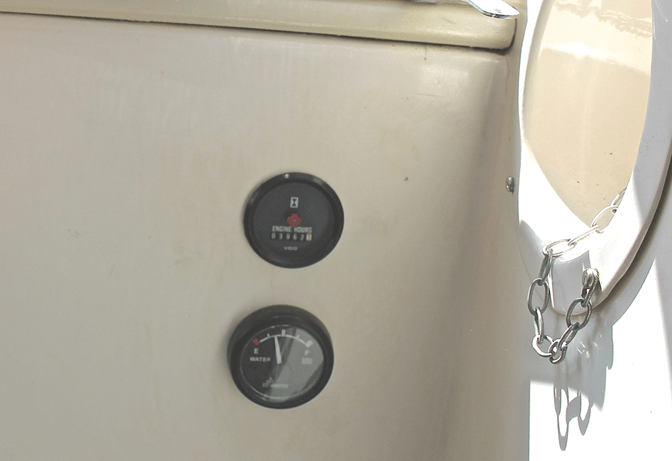
BE CAREFUL and DON’T LEAVE the Boat while filling as the gauge misreads.
If it overflows then the water pours into the bilge where smelly demons and bitey things lurk in the murky water. To remove this water, you need to pump it out using the bilge pump.
When it reads empty there will still be about 80 litres in the tank.
Power/Electrical
The Ports have 230 volts supply available adjacent to the berths. There are a range of fittings under the salon couch in a box for the Shore Power Lead.
The Thule pod requires its own key to unlock it and lock it, and the key cannot be removed unless the pod is locked. The brown box shown below has been replaced with a Thule Pod on the cabin top.
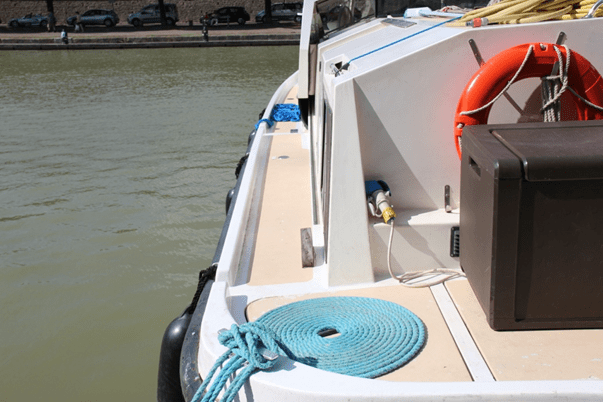
- Be sure that the lead can’t dangle into the water if the boat shifts in the breeze overnight.
- The charge for power is included in the berthage price.
- There are usually some unpowered sites which are cheaper, but why would you? You need power to charge the house batteries and run the fridge to keep the beer cold.
- All wall sockets (hot points) onboard are 230 volts AC and when on shore power all have electricity connected to them, but when underway they are dead.
- There are a range of sockets and adapters in the basket on the wall above the hand basin in the front bedroom.
- When underway, to keep the fridge cool, plug it into the blue-inverter behind the driver’s seat and switch the inverter on.
- Whenever the engine is going, the household and starting batteries are being charged.
- The household batteries (All replaced August 2022) are located under the lounge floor and the starter battery is located in the engine compartment.
- The engine battery is only being charged when the engine is going and not when the shore power is connected.
- Before you go back onto shore power, turn the inverter off and plug the fridge back into the wall socket.
- The inverter converts the 12volt DC battery power into 230 volts AC. It is fed by the house batteries.
Note: When on shore power, you must turn off the water heater if you use the electric jug or toaster or hair dryer, otherwise multiple heavy loads will trip the main circuit breaker located in the front bathroom.
Only use one of: electric jug/toaster/electric hot water/hairdryer at any one time.
- When on shore power, make sure that the battery charger (under the stair opposite the helm station) is plugged in.
- At night this battery charger can be switched to “night” mode by pressing MODE button for 3 seconds.
This makes the charger very quiet and runs at a lower charge rate.
- Remember to press and hold MODE button for 3 seconds following morning to go back onto full day charging.
- The household batteries will then be being charged.
- All wall and ceiling lights run off the 12-volt supply (except the plug-in lamp and one light in the front Br), as does the radio.
- The shaver outlets are unreliable and should not be used.
Electric circuit board and Fuse Box
- These are located in the front bathroom behind the lift out panel beside the toilet.
- The spare fuses are in the box of electrical spares under the front bed.
- On the hinged board are the terminal boxes for neutral and earth (Left hand one) and positive (righthand of the two).
- Beside these is the 16 Amp circuit breaker.
- Most of the 230-volt wiring is in conduits.
The plywood board can be hinged up for inspection of the terminal connections.
Disconnect shore power when working in this space.
House Batteries
- These are ‘Wet” lead acid type so about every month, check electrolyte levels. (Battery top up water bottle by battery box) – all four house batteries were replaced by new ones in June 2022.
- 4-stroke Honda 230volt generator lives in the stern engine locker and is secured with a bike lock.
- The lead for this connects its outlet to the shore-power inlet on the outside of the rear cabin on the port side.
- The petrol for this (91 0ctane-no added oil) is in the small red plastic container in the port rear locker. The Honda fuel tank takes 3.6 litres. The oil in the generator sump should be changed every 100 hours or each season.
- Refer ships papers. The genset spark plus is type NGK-CR5HSB or equivalent.
Make sure that the Hot Water switch (beside the scabbard for the roof sprocket handle) is off before starting the generator.
(The HWS pulls too much power for the Jenny)
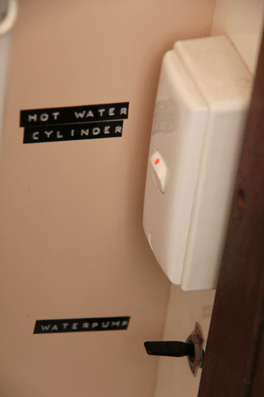
Elect Hot Water On/Off switch 1
- The toggle switch marked water pump below this hot water switch is the hot water pump and is a separate pump to the cold water pressure pump.
- The on/off switch for the cold-water pressure pump is found on the dashboard just bottom left of the steering wheel.
- If you want to use the generator connected to something else e.g. a barbecue, then you will need to earth it. This is a somewhat complex and risky exercise, so better not unless you know how to earth it by connecting an earthing lead to a stake driven into the ground.
- The petrol in the jenny will last about 3 hours. Park it down wind and away from the boat because of noise and carbon monoxide production.
If you leave it out all night it may grow wheels and disappear !! – Approx NZD 2200 for a new one. Make sure it is locked into the rear locker where it lives.
Gas for hob top/stove
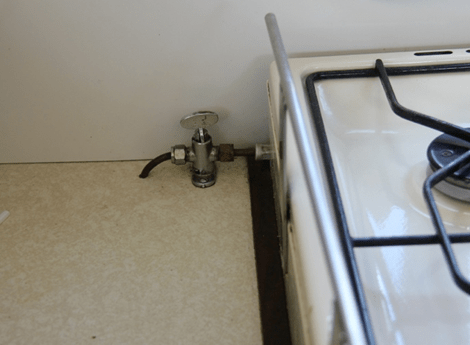
Complete rejig of gas for hob top/stove due to leak from old system. Could not update old system as the pipe had an English fitting which rendered the system unserviceable. Butane cylinder is now in cupboard next to stove. One bottle lasted us for 10+ weeks (we replaced it before it was empty when we left – August 22).
Fridge
The fridge is very efficient when on shore power and overnight it will freeze your ice.
- It is worthwhile putting some bottles of water in the freezer compartment for freezing and then transfer them into the cold compartment during the day if travelling.
- Use these frozen bottles in the fridge at night when Freedom parking, it saves the batteries.
- We connect it to the inverter when travelling or freedom parking (keep it at about 3 on the fridge control dial).
- When back on shore power don’t forget to plug it directly into a wall socket when you can turn it up to 4 or 5 again.
 Canal Boat Tui